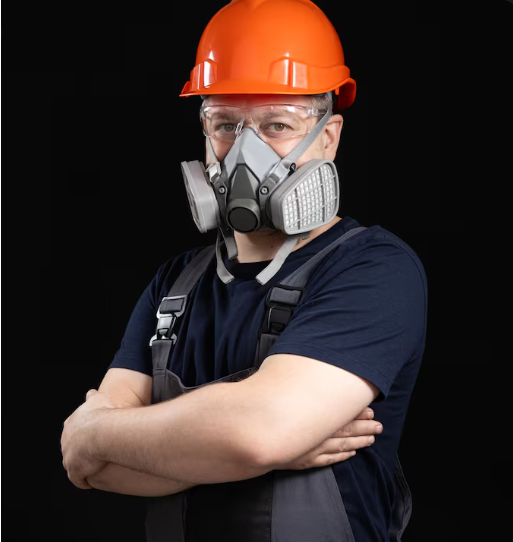
Facial hair creates a challenge in workplaces where employees need respiratory protection. Many disposable and reusable masks depend on close contact with the skin to stop contaminated air from entering around the edges. When a beard or heavy stubble crosses that sealing area, the wearer may not receive the protection expected.
For employers, the answer is not simply to issue a larger mask or tighten the straps. The task, contaminant, working environment and individual wearer must all be considered before suitable respiratory protective equipment is selected.
Why Tight-Fitting Masks May Not Be Suitable
Tight-fitting disposable masks, half masks and full-face respirators work only when they form an effective seal against the face. The Health and Safety Executive states that facial hair makes it impossible to achieve a good seal with this type of equipment. Gaps can allow unfiltered workplace air to bypass the filter and enter the breathing zone.
This is why looking for a conventional dust mask for beards can be misleading. A product may cover the beard, but coverage alone does not create a reliable seal. Tightening the straps can also cause discomfort without solving leakage around facial hair.
Where tight-fitting protection is used, the wearer should be clean-shaven in the sealing area and face-fit tested for the specific make, model, type and size supplied.
How a Powered Air System Works
A powered air purifying respirator uses a battery-powered fan to draw contaminated air through suitable filters before delivering cleaned air to a hood, helmet or visor. In a loose-fitting configuration, the headtop does not rely on a close facial seal in the same way as a disposable mask.
This can make a powered hood or visor a practical option for workers who cannot achieve a face seal because of facial hair. The airflow may also reduce breathing resistance during longer or physically demanding tasks. HSE guidance identifies ventilated hoods, positive-pressure hoods and visors as alternatives that may be considered for workers with beards.
Powered equipment is not automatically suitable for every hazard. The filters, protection level and headtop must be selected for the contaminant and exposure level identified by the workplace risk assessment.
When Powered Protection May Be Worth Considering
Powered systems may be useful in woodworking, construction, manufacturing, agriculture and other environments where airborne dust is generated. They can also be considered where a worker needs respiratory protection alongside eye, face or head protection.
A hood or visor may offer a more workable solution when spectacles, hearing protection or other PPE interfere with a conventional mask. It may also help during longer tasks where heat, breathing resistance and comfort influence whether equipment is worn correctly.
The decision should still follow the hierarchy of control. Dust extraction, ventilation, enclosure, water suppression and changes to the process should be considered before relying on RPE. Respiratory equipment protects only the wearer, whereas controls at source can reduce exposure for everyone nearby.
What Employers Should Check
The first step is to identify the hazard. Dust filters do not protect against every gas, vapour or oxygen-deficient atmosphere. Employers must understand what is in the air, how much exposure is likely and how long the work will continue.
The equipment must then be matched to the worker and task. Weight, field of vision, communication, mobility and compatibility with other PPE can affect practical use. Workers should be involved in trials because uncomfortable or obstructive equipment is less likely to be worn correctly.
Battery duration and charging arrangements also need attention. Employers should plan for charging, spare batteries and pre-use checks so that a unit does not lose power during a shift.
See also: Foil Blocking for Premium Packaging: How to Choose the Right Equipment and Finish
Maintenance Is Part of the Protection
Powered respirators contain components that require regular care. Filters must be replaced according to the manufacturer’s instructions and conditions of use. Hoses, seals, visors, airflow indicators and battery packs should be inspected for damage.
Headtops must be cleaned and stored to prevent contamination. Employees also need training in assembly, use, checks, cleaning and fault reporting. HSE advises employers to follow manufacturers’ maintenance schedules and ensure that RPE is checked, maintained and stored correctly.
Conclusion
Bearded workers should not rely on tight-fitting equipment that cannot form an effective seal. A loose-fitting powered system may offer a suitable alternative, but only after a competent assessment confirms that it provides adequate protection for the hazard and task.
The best solution combines control at source with correctly selected and maintained RPE. By assessing individual needs rather than issuing one mask to everyone, employers can create a respiratory protection programme that is both safer and more practical.


