Introduction
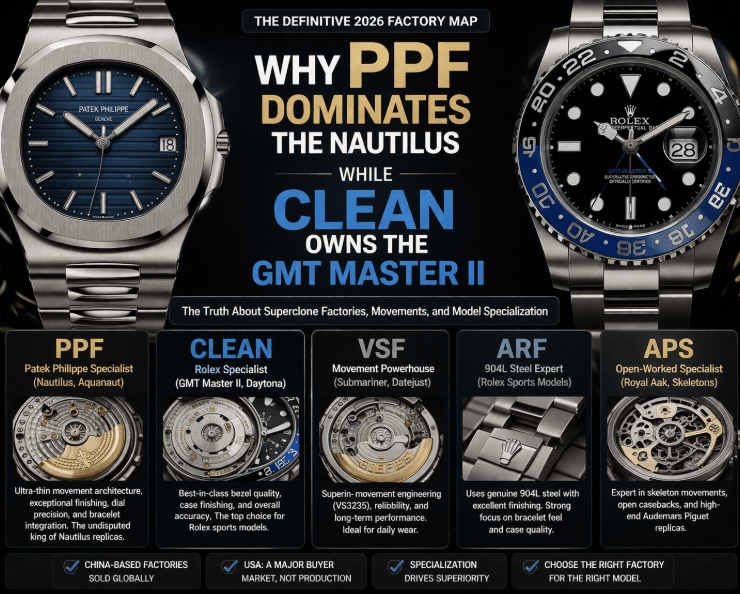
One of the biggest mistakes buyers make when entering the world of superclone watches is assuming that one factory dominates everything. In reality, the superclone market in 2026 is highly specialized, with different factories excelling in different models. This is why a Patek Philippe Nautilus from PPF feels fundamentally different from a Rolex GMT Master II produced by Clean Factory.
For buyers across the USA, where demand for high-end replica watches continues to grow, understanding this factory specialization is critical. The truth is simple: PPF dominates the Nautilus due to its ultra-thin movement architecture and finishing precision, while Clean Factory leads the GMT Master II space through superior bezel construction and case accuracy. This guide explains exactly why.
Why Factory Choice Matters More Than Most Buyers Realize
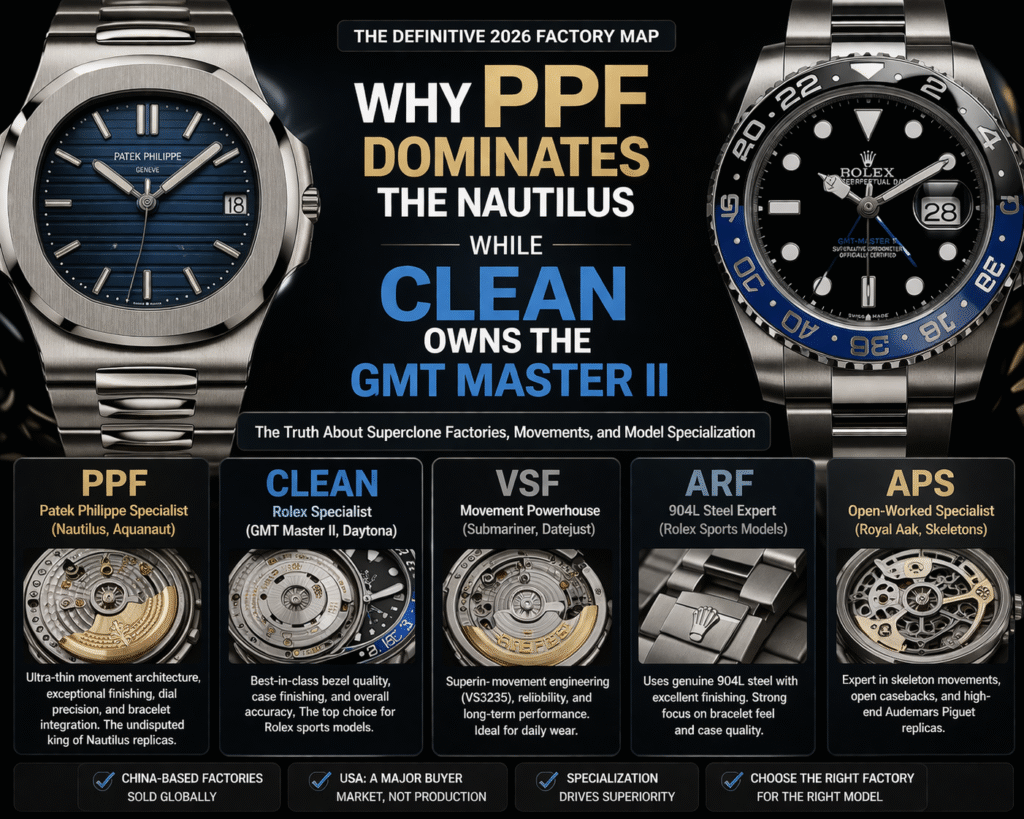
The superclone watch market is no longer about generic replicas. Factories such as PPF, Clean, VSF, and APS are highly specialized operations based in China, each focusing on specific models and engineering priorities. However, many buyers in the USA still choose watches based purely on appearance, ignoring how factory specialization directly affects performance, durability, and realism.
In practice, the difference becomes obvious after extended wear. A watch that looks perfect but lacks proper movement engineering will struggle with timekeeping consistency. Conversely, a technically advanced movement paired with weak finishing will lack authenticity on the wrist. The key is understanding which factory is best for which model, and why.
Movement Architecture and Performance Differences
To understand why PPF and Clean dominate their respective categories, you need to look at the movement architecture they build around. PPF’s strength lies in its use of ultra-thin clone calibers, particularly in Nautilus models. These movements are designed to replicate the slim profile of genuine Patek Philippe calibers, which requires precise gear train alignment and reduced component height.
The gear train in these movements is engineered for efficiency, allowing energy to transfer smoothly from the mainspring through the escapement system. This results in stable amplitude and a clean, consistent seconds sweep, even in a thinner case profile. Achieving this balance between thinness and stability is extremely difficult, which is why PPF stands out in this segment.
Clean Factory, on the other hand, focuses heavily on Rolex GMT Master II models, where bezel construction and case geometry are critical. The movement inside these watches, often based on VR or modified clone calibers, is designed for robustness and reliability. However, the real advantage comes from Clean’s CNC machining process. Their cases are cut with high precision, ensuring that crown guards, lugs, and rehaut engravings align closely with genuine Rolex specifications.
The result is a watch that not only performs reliably but also achieves a level of visual accuracy that is extremely difficult to distinguish from the original.
PPF vs Clean vs the Wider Market
PPF has carved out a niche in the superclone industry by focusing on Patek Philippe models, particularly the Nautilus. Their production process emphasizes dial finishing, case thinness, and bracelet integration. The brushing on the Nautilus case and the way light reflects across the horizontal dial pattern are details that PPF has refined over multiple iterations.
Clean Factory, in contrast, has become the benchmark for Rolex sports models, especially the GMT Master II and Daytona. Their bezel inserts, often made from ceramic, are color-matched to genuine Rolex standards. This includes subtle details such as the fade between colors on Pepsi and Batman bezels, which many lower-tier factories fail to replicate accurately.
VSF remains a key player in the market, particularly for Submariner and Datejust models, due to its focus on movement engineering and long-term reliability. Meanwhile, ARF is known for its use of 904L steel and bracelet construction, and APS specializes in complex open-caseback movements such as those found in Audemars Piguet models.
This ecosystem of specialization is what defines the modern superclone market. No single factory dominates every category, and understanding these strengths is essential for making the right choice.
Nautilus vs GMT Master II
The difference between PPF and Clean becomes most apparent when comparing their flagship models. The Nautilus, with its integrated bracelet and slim case profile, requires a level of precision that goes beyond simple replication. PPF’s ability to maintain case thinness while ensuring movement stability is what gives it an edge in this category.
On the wrist, a PPF Nautilus feels balanced and refined. The bracelet articulation is smooth, and the case sits close to the wrist, replicating the feel of a genuine Patek Philippe.
In contrast, the GMT Master II demands a different type of engineering. The watch is defined by its bezel, which must rotate smoothly while maintaining precise alignment. Clean Factory excels here, producing bezels with crisp engraving and accurate color transitions. Combined with strong case finishing and reliable movement performance, this makes Clean the dominant choice for GMT models.
How to Choose the Right Factory
For buyers in the USA, choosing between PPF and Clean comes down to the model and intended use. If you are interested in a Nautilus or other Patek Philippe models, PPF is the clear choice due to its expertise in thin case construction and dial finishing. If your focus is on Rolex sports models like the GMT Master II, Clean Factory provides superior results in terms of bezel accuracy and overall finishing.
Understanding this distinction is what separates experienced buyers from beginners. Many first-time buyers make the mistake of choosing based on price alone, only to realize later that the factory was not suited to the model they selected.
Real-World Buyer Insights Across the USA
In cities like New York and Chicago, where buyers tend to prioritize long-term performance and practicality, VSF and PPF models are often preferred. In contrast, buyers in Los Angeles and Miami frequently choose Clean Factory models due to their visual impact and finishing quality.
For collectors in the USA market, it is common to own multiple watches from different factories, each selected for a specific purpose. A PPF Nautilus might serve as a refined dress watch, while a Clean GMT Master II functions as a more robust, everyday piece.
Understanding Pricing in 2026
The pricing of superclone watches reflects both movement complexity and factory specialization. PPF Nautilus models tend to be priced higher due to the difficulty of producing ultra-thin movements and integrated cases. Clean GMT Master II models also command strong prices due to the precision required in bezel production.
However, value should always be considered alongside price. A watch that is well-matched to its factory will deliver better long-term satisfaction than a cheaper option that compromises on key details.
Maintenance and Ownership
High-end superclone watches built by PPF and Clean operate on the same mechanical principles as genuine watches. When properly maintained, they can deliver comparable performance in terms of timekeeping and durability. Regular servicing, careful handling, and proper storage are essential for preserving movement integrity.
These watches are also designed to be fully waterproof when properly sealed, aligning with the expectations of genuine luxury sports watches.
USA Market Demand
The USA remains one of the largest markets for superclone watches, with strong demand in New York, Los Angeles, Miami, Chicago, Houston, Dallas, and San Francisco. Buyers in these cities are increasingly knowledgeable, often comparing factories and movements before making a purchase.
This growing awareness has driven factories like PPF and Clean to refine their production processes, resulting in the high level of quality seen today.
Why Choose SuperCloneWatch
SuperCloneWatch provides access to carefully sourced models from leading factories such as PPF, Clean, and VSF. By focusing on verified factory sourcing and strict quality control, they ensure that buyers receive watches that match their expectations in both performance and finishing.
For those looking to understand factory differences in more detail, this top tier watch factory comparison
offers additional insights into how different manufacturers approach watchmaking.
Conclusion
The modern superclone market is defined by specialization. PPF dominates the Nautilus because of its expertise in ultra-thin movement architecture and finishing precision, while Clean Factory leads the GMT Master II category through superior bezel construction and case accuracy. Understanding these differences allows buyers to make informed decisions based on real technical factors rather than surface-level comparisons.


