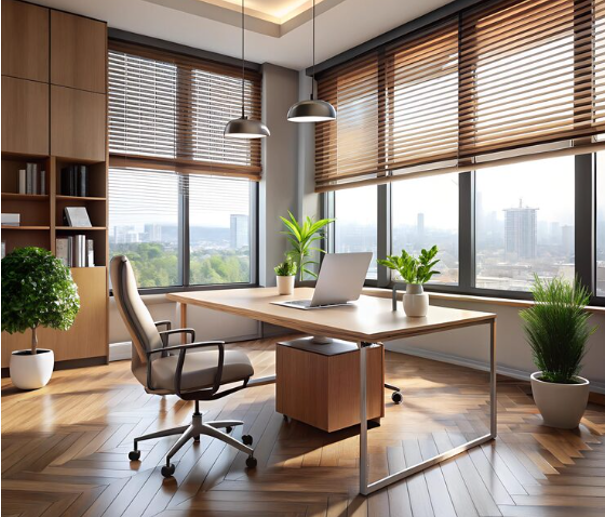
Window coverings in a commercial building should do more than match the décor. They influence glare, privacy, temperature, presentation and the comfort of employees and visitors. However, using the same blind across an entire workplace rarely produces the best result because each area serves a different purpose.
Open-plan offices need practical daylight control, meeting rooms may require privacy, and reception areas must create a strong first impression. A well-planned specification considers how each space is used before selecting materials, colours and operating systems.
Begin With a Room-by-Room Assessment
Before comparing products, review the building as a collection of working zones rather than one large project. Note the direction each window faces, the amount of direct sunlight it receives and whether nearby screens or workstations are affected by glare.
The assessment should also consider:
- Window dimensions and opening mechanisms
- Privacy requirements
- Frequency of use
- Cleaning and maintenance access
- Compatibility with furniture and equipment
This information creates a clearer basis for selecting commercial blinds that support the needs of each department instead of applying one standard solution everywhere.
Prioritise Glare Control in Open-Plan Offices
Employees working at computers may experience discomfort when direct sunlight reflects from screens. Completely blocking daylight is not always desirable, as natural light can make the workplace feel more welcoming and reduce dependence on artificial lighting.
Light-filtering roller or vertical blinds can help soften bright sunlight while maintaining a comfortable level of daylight. The chosen fabric should reduce glare without making the space unnecessarily dark.
Workstation layout should also influence the specification. Windows positioned behind or directly opposite screens may require stronger control than glazing in circulation areas. Adjustable blinds allow employees to respond to changing sunlight throughout the day.
Treat Meeting Rooms as Flexible Spaces
Meeting rooms are used for presentations, video calls, confidential discussions and client conversations. Their blinds therefore, need to support more than one activity.
A room used for screen presentations may require a dim-out fabric that reduces outside light. A ground-floor meeting room may need greater privacy from people passing outside. Where several windows are present, individual controls can allow one section to remain open while another is closed.
Motorised operation may be useful in larger meeting rooms or where windows are difficult to reach. Controls should remain simple enough for visitors and employees to operate without technical assistance.
Make Reception Areas Part of the Brand Experience
Reception is often the first part of the workplace seen by customers, applicants and suppliers. The blind design should therefore support the company’s visual identity as well as provide practical light control.
Colour, fabric texture and finishing details should coordinate with signage, furniture and interior branding. A clean, consistent installation generally creates a stronger impression than several unrelated blind styles.
Durability matters because reception areas often experience high levels of use. Materials should be easy to maintain and suitable for the surrounding environment. The blinds should also avoid obstructing external signage or making the entrance feel unnecessarily enclosed.
Choose Office Blinds for Practical Daily Use
The best office blinds should be straightforward to adjust, clean and maintain. Complex systems may look impressive initially but can become inconvenient if employees do not understand how to use them.
When comparing options, consider:
- How frequently the blinds will be operated
- Whether manual or motorised control is more practical
- How easily fabrics can be cleaned
- Whether replacement parts are readily available
- Who will be responsible for routine maintenance
In kitchens, washrooms or healthcare-related environments, moisture-resistant and easy-clean materials may be preferable. In executive areas, appearance and privacy may carry greater importance.
Coordinate Colours Without Using One Product Everywhere
Brand consistency does not require every room to have identical blinds. Different products can still feel coordinated when they share a colour palette, finish or design language.
For example, roller blinds may suit meeting rooms, vertical blinds may work well across wide office windows, and motorised systems may be selected for high-level glazing. Using related colours or fabrics can connect these areas visually while allowing each product to perform its specific role.
Physical samples should be viewed in the building because colours can appear different under artificial lighting and changing daylight.
See also: The Importance of Financial Planning in Business
Plan Installation Around Business Operations
Commercial fitting should be scheduled to minimise disruption. Installation may require desks to be moved, meeting rooms to be temporarily unavailable or access equipment to be positioned near entrances.
A phased programme can help businesses keep essential areas operational. Measuring should be completed accurately before manufacture, particularly where windows vary slightly in size.
The installer should also check whether drilling, electrical work or coordination with other contractors is required. Resolving these details in advance reduces delays and avoids disruption during working hours.
Conclusion
Specifying blinds for a commercial building requires more than choosing one design and repeating it across every window. Offices, meeting rooms and reception areas each have different requirements for glare control, privacy, operation and presentation.
A room-by-room approach allows businesses to select practical products while maintaining a consistent visual identity. By considering sunlight, daily use, maintenance and installation planning from the beginning, organisations can create a more comfortable workplace and achieve a professional finish that supports both employees and visitors.


