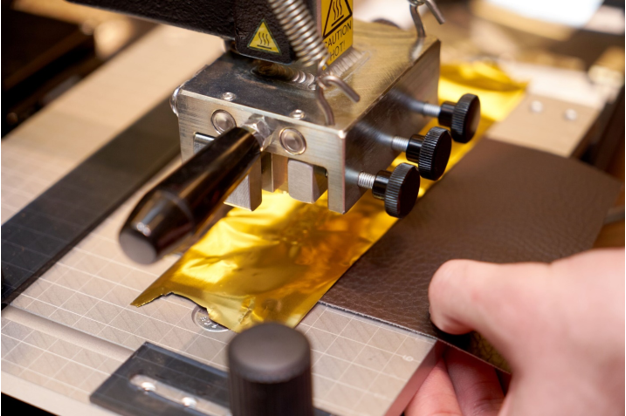
The finishing detail on a premium product often does more work than the logo itself. A recessed mark can suggest restraint and craftsmanship, while a reflective metallic design can create immediate impact. This is why the choice between debossing and hot foil should begin with the personality of the product, not simply with the technique that looks more decorative.
The right option depends on what the customer should notice, how the surface behaves and how the product will be handled.
Start With the Brand Message
A debossed design is pressed into the material, creating a visible and tactile indentation. It often feels quiet, confident and refined. For brands built around natural materials, minimal design or understated luxury, this can be a strong fit.
Hot foil creates a more immediate impression. A metallic, matt or coloured layer is transferred onto the surface using heat and pressure. The result is brighter, more noticeable and more decorative.
A heritage leather brand may prefer a deep, uncoloured mark. A cosmetics company launching a gift range may choose gold or copper foil to catch the light. Neither approach is automatically more premium; the better finish is the one that supports the brand story.
Consider How the Product Will Be Seen
Debossing relies on depth, shadow and texture, so it performs best when the surface allows the impression to remain visible. Smooth leather, thick card and uncoated board often show recessed marks well.
On dark, highly textured or patterned materials, the design may become less obvious. In these cases, hot foil can offer stronger contrast and make the branding easier to notice.
A small foil detail can guide the eye towards a logo or product name without covering the entire surface. This makes it especially effective for packaging displayed on shelves or used in gift presentations.
Let the Artwork Guide the Process
Bold logos, simple monograms and strong shapes usually adapt well to either method. Very fine lines, tiny lettering and tightly spaced details need more careful treatment.
A recessed impression can lose definition if the artwork is too delicate or the material is too soft. Foil can also fill small gaps if the temperature or pressure is too high.
Before production, artwork may need to be simplified or resized. Testing a sample die on the intended material is often more useful than judging the design on a screen.
Match the Finish to the Material
Material choice strongly influences the result. Thick card and firm leather can often hold a visible debossed impression, while thin paper or fragile board may distort under heavy pressure.
Hot foil introduces another consideration: heat sensitivity. Laminates, synthetic leather, coated papers and certain plastics can react differently at higher temperatures. The foil grade must also be compatible with the surface.
The same settings should not be applied to every job. Testing should be completed on the actual production material, not on a similar substitute.
Production Priorities Matter
For repeated production, consistency becomes important. Debossing requires stable pressure and accurate positioning. Hot foil requires control of pressure, temperature and dwell time. If these vary, the result may appear uneven from one item to the next.
Businesses should also consider setup time, die cost, waste levels and the skill required to reproduce the finish. A visually impressive result is only useful if it can be achieved consistently across the full order.
Positioning guides and recorded machine settings can make repeat jobs more reliable, particularly when producing large quantities of branded products.
See also: Foil Blocking for Premium Packaging: How to Choose the Right Equipment and Finish
When a Combined Finish Works Best
Some products benefit from using both techniques together. A logo can be pressed into the surface and finished with foil, creating depth, colour and a stronger tactile effect.
This works particularly well for presentation boxes, premium notebooks and branded leather accessories. However, it requires accurate alignment and controlled machine settings. It should be a deliberate design choice rather than an automatic upgrade.
Combining the two finishes may also increase setup time, so it is best reserved for products where the added detail supports the intended selling price and brand position.
Conclusion
Choose debossing when the product needs a subtle, tactile and restrained finish. Choose hot foil when stronger visibility, colour or reflective detail is important. Consider the material, artwork, production volume and intended brand impression before deciding.
The most reliable approach is to test both options on the actual product. A physical sample reveals more than a digital mock-up and helps ensure that the chosen finish performs consistently and adds real value to the final design.


