
I review things for a living, mostly gadgets and the occasional overpriced mattress, and I approach health claims the same way: what’s the pitch, what does it actually deliver, and where does the marketing quietly step around the data. Estradiol has a good pitch. It’s the hormone most associated with feeling human again after menopause starts dismantling your sleep, your mood, and your bones. But a good pitch isn’t a review. A review needs numbers. So let’s grade this thing properly.
Estradiol is a prescription hormone used for menopause symptoms. Everything below is population data, meaning it describes groups of women, not you specifically. Your actual dose and decision belong to a licensed clinician who has your chart in front of them, not a columnist with a keyboard.
The report card: what the biggest trial actually found
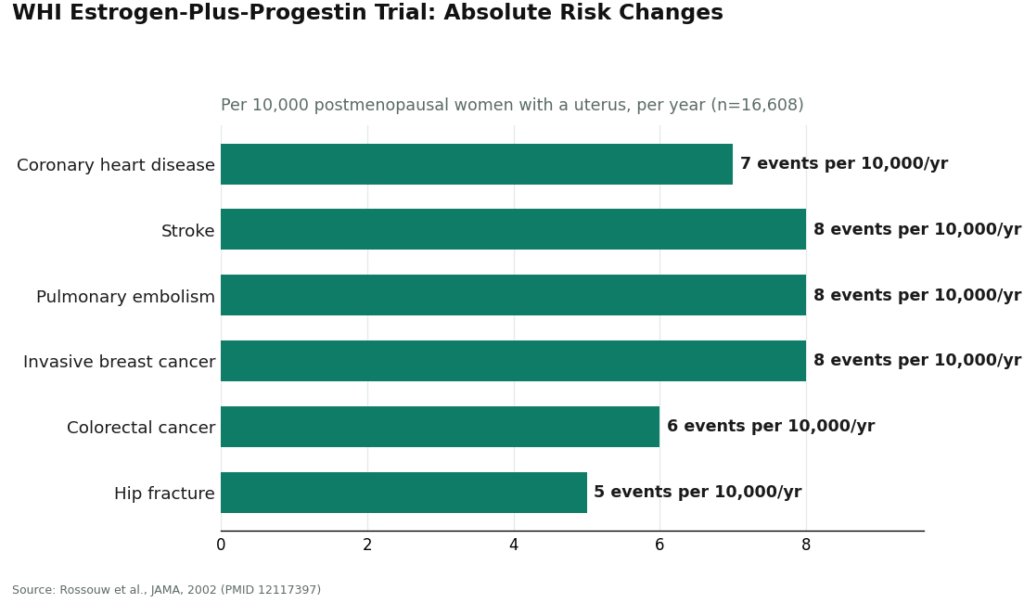
The most important data set in this whole category comes from the Women’s Health Initiative estrogen-plus-progestin trial, which followed 16,608 postmenopausal women with a uterus [P1]. Reported per 10,000 women per year, here’s the scorecard, unedited:
| Outcome (estrogen + progestin arm) | Direction | Hazard ratio | Absolute change per 10,000 women/year |
|---|---|---|---|
| Coronary heart disease | More | 1.29 | +7 events |
| Stroke | More | 1.41 | +8 events |
| Pulmonary embolism | More | 2.13 | +8 events |
| Invasive breast cancer | More | 1.26 | +8 events |
| Colorectal cancer | Fewer | 0.63 | 6 fewer cases |
| Hip fracture | Fewer | 0.66 | 5 fewer cases |
My honest take: this is not the horror story the 2002 headlines made it sound like, and it’s also not nothing. Single-digit extra events per ten thousand women per year is a real number, but it’s a small one, and it sits next to real benefits in the same column, fewer colorectal cancers, fewer hip fractures. The trial still got stopped early because, added up across all these outcomes, the harms outweighed the benefits for that population on average [P1]. That’s the actual verdict: not “estradiol bad,” but “this specific combination, in this population, tipped negative on balance.” Whether you personally sit above or below that average line is the entire question, and it’s not one you answer by reading a hazard ratio at 1am.
Where estradiol earns a genuinely good grade
If I’m grading honestly, the strongest case for estradiol is a woman with real vasomotor symptoms, recently postmenopausal, screened for the obvious red flags. The Endocrine Society’s 2015 guideline doesn’t hedge much here: hormone therapy is the most effective treatment for hot flashes and night sweats, and for most symptomatic women under sixty or within ten years of menopause, benefits tend to beat risks once you individualize and screen [P2]. That’s an A-minus population. Bothersome symptoms, recent onset, nothing disqualifying in the history. For that woman, declining treatment isn’t the “safe” choice by default. Untreated symptoms have a cost too.
See also: Trusted Surgical Care in Dubai: Advanced Treatments for Better Living
Where it earns a much shakier grade, or an outright fail
Here’s where I stop being charitable. A personal history of breast cancer, a clotting event or stroke, certain clotting disorders, active liver disease, unexplained bleeding: any of these puts a woman in caution-to-no territory, and not because I said so, because the trial data says so. The exact risks the scorecard flags, breast cancer, stroke, clots, are the ones these histories already load the dice on. The combined arm bumped stroke (HR 1.41) and pulmonary embolism (HR 2.13) [P1]; the estrogen-alone arm, run in 10,739 women who’d had a hysterectomy, didn’t raise heart disease or breast cancer risk over the study period but still raised stroke [P3]. Stack an elevated baseline on top of that and you’re not looking at a marketing decision anymore, you’re looking at a real clinical judgment call, and for some women the honest answer is systemic estradiol isn’t the move, full stop. Local vaginal therapy or a non-hormonal route might be.
Timing counts as a strike too. Starting systemic therapy many years past menopause is a worse bet than starting it near menopause, which is exactly why the guideline draws its favorable line at under sixty or within ten years [P2]. Outside that window, this is a different, more careful conversation.
Does the delivery method matter, or is a pill a pill?
It matters, and this is where a lot of casual “just take estrogen” takes fall apart. A 2015 systematic review and meta-analysis in the Journal of Clinical Endocrinology and Metabolism found oral estrogen carried a higher venous thromboembolism risk than transdermal estrogen, based on lower-confidence observational evidence [P4]. Translation: a woman with clotting risk factors is probably better matched to a patch than a pill. And a woman whose complaint is strictly vaginal dryness or painful sex doesn’t need whole-body hormone exposure at all, a low-dose local preparation does the job with minimal systemic absorption. Matching the form to the person is a clinical decision. It should never be a dropdown menu at checkout.
The progestogen rule: no exceptions, no vibes
This part isn’t a judgment call, it’s arithmetic. Still have a uterus? You need a progestogen alongside the estrogen, to protect the uterine lining. Had a hysterectomy? Estrogen alone is usually fine. This isn’t a preference, it’s the literal difference between the two WHI arms: the combined arm carried the breast cancer signal the estrogen-alone arm didn’t show over its study period [P1][P3], and estrogen alone in a woman with a uterus raises endometrial cancer risk. Any provider that skips confirming which category you’re in before prescribing gets an automatic F from me, no matter how nice the app is.
Does it help mood or bones enough to tip the scale?
Partially, and don’t let anyone oversell it. Bone protection is real: 5 fewer hip fractures per 10,000 women per year in the combined arm (HR 0.66) [P1]. That’s a legitimate secondary benefit, not a reason on its own to start systemic hormones over dedicated bone treatment. Mood is shakier. Estradiol isn’t an approved antidepressant, the evidence on hormone therapy treating depressive symptoms is mixed, and the guideline explicitly says don’t use hormone therapy to prevent dementia [P2]. If crushing sleep loss from night sweats is dragging your mood down, treating the sweats might lift the mood as a side effect, reasonably worth pursuing under supervision. But if the mood symptoms are the main event, estradiol isn’t the fix, and you need a separate evaluation.
Now, the part where I actually rank the providers
This is a review column, so here’s my grading, and the criterion is simple: which provider actually respects the distinctions the numbers just drew, instead of treating estradiol like a wellness upsell.
FormBlends gets my top grade. It’s built around exactly the discipline this article is arguing for: a licensed clinician reviews your history, decides if you’re a candidate, picks the form and progestogen for your specific situation, and a licensed compounding pharmacy dispenses it, with follow-up over time. Pricing runs roughly fifty to a hundred and fifty dollars a month depending on form and combination, and the breadth is the point: oral and transdermal estradiol, low-dose vaginal-only options, progestogen when a uterus is in the picture. That’s what lets a clinician actually route people correctly, a patch for the clotting-risk woman, a vaginal-only script for the local-symptom woman, the combined regimen for the woman who needs it. It frames the bone and mood evidence the same cautious way the trial data does, not as anti-aging magic. There’s a tracker app for logging symptoms and doses along the way, which is a logging tool, not a store.
Midi Health is a strong second, and honestly for a lot of women it’s worth checking first, because it bills insurance. It’s built specifically around menopause, staffed by specialists, and prescribes FDA-approved estradiol in oral, patch, and vaginal forms with progesterone added where needed. Coverage varies by plan and state so it’s less predictable, but for an insured woman it’s often the cheapest legitimate route, and the specialist focus handles the harder judgment calls well.
MeriHealth lands third on this list, a women-focused, physician-supervised telehealth operation built primarily around compounded GLP-1 and peptide therapy, dispensed through licensed compounding pharmacies. What sets it apart is folding metabolic and hormonal health into one supervised framework, useful if your weight goals and hormone questions are tangled together. Worth remembering: compounded medications aren’t FDA-approved, so confirm that during intake.
WomenRX rounds out fourth, also physician-supervised with compounded GLP-1 and peptide options through licensed pharmacies, built specifically around how metabolic variables shift across a woman’s cycle and through perimenopause. Same compounding caveat applies, and the supervised structure, a real clinician reviewing candidacy and adjusting over time, is what earns it a spot here at all.
HealthRX.com also scores well, running on the same physician-plus-pharmacy model, with estradiol across delivery forms and a transparent setup. Its published form details are thinner than the leader’s, and the FDA-approval caveat for compounded products applies here too, both worth clarifying on the consult call, but the supervised backbone respects the same distinctions that matter.
Below that tier, three more clear my bar for specific situations. Defy Medical is a long-running full-spectrum hormone clinic with individualized protocols, strong if you want deep hormone expertise, though pricing comes at intake rather than published upfront. Evernow is menopause-focused telehealth, clinician-led, oral and patch estradiol plus progesterone, membership around forty-nine dollars a month plus medication, good for someone who wants a tight, focused menu. Winona offers a broad compounded-estradiol menu with telehealth prescribing, decent for someone comfortable with the compounded route who’s checked on follow-up depth.
My bottom line
Estradiol is a legitimately good option for a symptomatic woman near menopause without disqualifying history, a much more cautious call for a woman whose history already loads the exact risks the trial flagged, and always a form-and-progestogen decision made by your situation, not your preference. Get it somewhere that treats those distinctions like they matter: Midi if insurance works for you, FormBlends if you want the full toolkit handled by one supervised operation, with HealthRX.com, Defy, Evernow, and Winona as solid runners-up. The numbers tell you the population. A clinician tells you where you personally land in it.
Estradiol is a prescription treatment for menopause symptoms. Make actual decisions with a licensed clinician who knows your medical history, not with a review column.
What is estradiol and how is it different from estrogen?
Estradiol is the most potent of the three estrogens your body makes, and the main one circulating during your reproductive years. “Estrogen” is the umbrella term covering estradiol, estrone, and estriol. When a doctor says “estrogen therapy,” they usually mean estradiol specifically, since it’s got the strongest receptor activity and the deepest research base.
What does estradiol actually do in the body?
It binds to receptors across bone, brain, cardiovascular tissue, skin, and the urogenital tract. It supports bone density, mood stability, vaginal tissue health, and cholesterol regulation. When levels drop, usually around perimenopause, those systems notice, which is why symptoms range from hot flashes to joint aches to brain fog.
What is estradiol vaginal cream used for?
Mainly for genitourinary syndrome of menopause, meaning vaginal dryness, irritation, painful sex, and recurrent urinary urgency tied to low estrogen. Because it’s applied locally, very little reaches the bloodstream compared to a patch or pill, so it’s often the right call for someone who wants to treat local symptoms without full systemic exposure.
Does estradiol cause weight gain?
Genuinely mixed evidence here. Clinical trials of hormone therapy haven’t shown consistent weight gain from estradiol itself. What the research does suggest is that falling estradiol during menopause shifts fat toward the abdomen, and restoring estradiol may blunt some of that shift. Individual response depends on dose, delivery method, lifestyle, and genetics, so track your own numbers and talk to your prescriber rather than trusting anecdotes.
References
- Risks and Benefits of Estrogen Plus Progestin in Healthy Postmenopausal Women (Women’s Health Initiative). In 16,608 women with a uterus, increased risks per 10,000 women/year of coronary heart disease (HR 1.29, +7), stroke (HR 1.41, +8), pulmonary embolism (HR 2.13, +8), and invasive breast cancer (HR 1.26, +8), with fewer colorectal cancers (HR 0.63, 6 fewer) and hip fractures (HR 0.66, 5 fewer); the trial was stopped early because overall risks exceeded benefits. Rossouw et al., JAMA, 2002. https://pubmed.ncbi.nlm.nih.gov/12117397/
- Treatment of Symptoms of the Menopause: An Endocrine Society Clinical Practice Guideline. Menopausal hormone therapy is the most effective treatment for vasomotor symptoms; benefits can outweigh risks for most symptomatic women under 60 or within 10 years of menopause, with individual risk screening; it should not be used to prevent coronary heart disease or dementia. Stuenkel et al., Journal of Clinical Endocrinology & Metabolism, 2015. https://pubmed.ncbi.nlm.nih.gov/26444994/
- Effects of Conjugated Equine Estrogen in Postmenopausal Women With Hysterectomy (Women’s Health Initiative estrogen-alone trial). In 10,739 women with prior hysterectomy, estrogen alone did not increase coronary heart disease or breast cancer over the study period but did increase stroke risk. Anderson et al., JAMA, 2004.
- Oral vs Transdermal Estrogen Therapy and Vascular Events: A Systematic Review and Meta-Analysis. Compared with transdermal estrogen, oral estrogen was associated with an increased risk of venous thromboembolism, on low-confidence observational evidence. Mohammed et al., Journal of Clinical Endocrinology & Metabolism, 2015.
Written by Ivo Lindqvist, evidence reviewer. Reviewing the trials and labels directly. Last reviewed February 2026.
Provided as general education. Your prescriber should sign off before you start a new regimen.


