The UK educational landscape in 2026 is vastly different from the start of the decade. With the complete rollout of digital-first GCSEs and A-Levels by boards like AQA and Pearson, and the normalization of hybrid learning environments at universities from London to Edinburgh, the pressure on students has reached a fever pitch.
The “always-on” nature of digital education means that the boundary between home and school has blurred. However, a new generation of high school and university students is fighting back. By moving away from “grind culture” and toward “precision learning,” UK students are finding ways to excel without sacrificing their mental well-being. If you are struggling to keep your head above water, here is how the most successful students are navigating academic pressure in 2026.
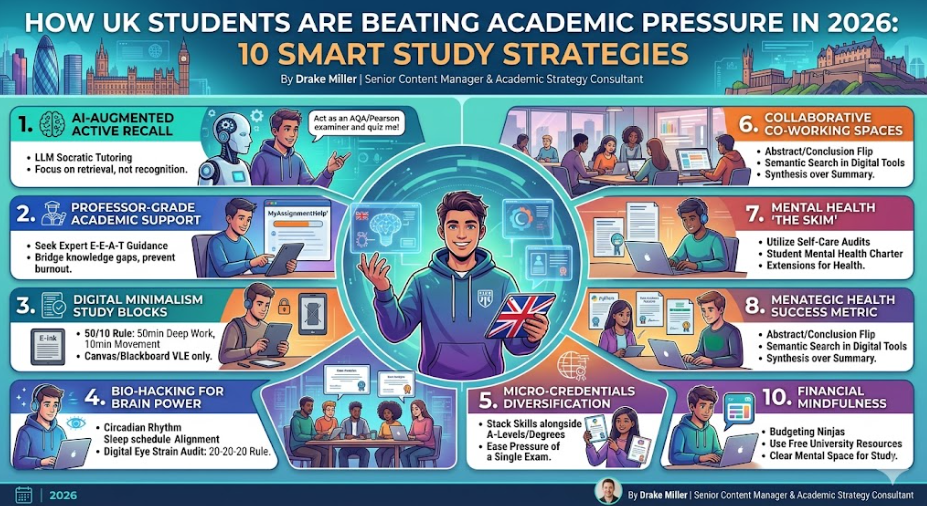
1. The Pivot to AI-Augmented Active Recall
Gone are the days of highlighting textbooks for hours—a method science has proven to be among the least effective for long-term retention. In 2026, the highest-achieving students use AI not to write their essays, but to audit their knowledge.
The strategy is simple: Active Recall. Instead of reviewing notes, students use platforms to generate mock exam questions based on the latest Pearson or AQA specifications. By forcing the brain to retrieve information rather than just recognize it, retention rates soar. For those tackling more specialized subjects, integrating law assignment help into their study routine allows them to master complex case law through interactive, expert-led retrieval practices rather than passive reading.
The 2026 Twist: Students are now using “LLM Socratic Tutoring.” Instead of asking an AI for the answer, they ask the AI to “act as an examiner and quiz me on the causes of the Industrial Revolution.” This interactive feedback loop reduces the anxiety of the unknown, making the actual exam feel like just another practice session.
2. Leveraging Professional Academic Support
Even with the best intentions, the sheer volume of coursework in the modern UK curriculum can become unmanageable. Whether it’s a complex Level 3 BTEC assignment or a final-year dissertation, the pressure to maintain a 1st or a 2:1 is immense.
One of the smartest strategies observed this year is knowing when to delegate and seek expert guidance. Many students are turning to get assignment help online at Myassignmenthelp.com to bridge the gap between classroom teaching and individual understanding.
Whether it’s getting a model paper to understand complex structures or receiving specialized tutoring in STEM subjects, professional support acts as a safety net. This isn’t about shortcuts; it’s about academic mentorship that prevents burnout.
3. The “Digital Minimalism” Study Block
The 2026 student faces a paradox: their tools are digital, but their biggest distractions are also digital. To combat this, “Deep Work” sessions have become a status symbol in UK libraries. Students are increasingly using “dumb tech” during revision phases—using E-ink tablets that don’t have social media capabilities or utilizing focus modes that lock every app except for the Virtual Learning Environment (VLE) like Canvas or Blackboard.
The Strategy: Use the 50/10 Rule. 50 minutes of deep, disconnected work followed by 10 minutes of movement. Notice that the break isn’t for scrolling social media; it’s for physical movement to reset the nervous system.
4. Bio-Hacking for Brain Power
In 2026, the conversation around “study drugs” has been replaced by a focus on cognitive health. UK students are increasingly looking at sleep as a “performance enhancer.”
- Circadian Rhythm Alignment: Savvy students are scheduling their most cognitively demanding subjects—usually Mathematics or Physics—during their natural peak alertness hours, rather than forcing a traditional 9-to-5 schedule.
- The “Blue Light” Audit: With most UK exams being digital-by-default, eye strain is a genuine productivity killer. The use of high-quality blue light filters and the 20-20-20 rule is now standard practice.
5. Micro-Credentials and Pressure Diversification
One reason academic pressure is so high is the “all-or-nothing” feeling of traditional degrees. In 2026, savvy students are easing this pressure by stacking micro-credentials alongside their main A-Levels or Degree modules.
By completing short, industry-recognized courses in Python or Data Analytics, students feel less “trapped” by a single exam result. This diversification of their CV means that if one exam goes poorly, they still have a portfolio of certified skills to show employers.
6. Collaborative “Co-Working” Spaces
Isolation breeds anxiety. In major UK student hubs like Manchester, Birmingham, and Leeds, we are seeing a rise in student-led “Study Squads.” These aren’t just social hangouts; they are structured co-working sessions where students hold each other accountable. Working in a “body doubling” environment significantly reduces the urge to procrastinate.
7. Strategic Reading and “The Skim”
The reading lists provided by UK universities in 2026 are longer than ever. The 2026 strategy is Strategic Reading:
- The Abstract/Conclusion Flip: Reading the end first to understand the “destination” of the paper.
- The “Semantic Search” Methodology: Utilizing digital tools to search for key terms related to the assignment prompt rather than reading linearly.
- Synthesis over Summary: Focus on how sources interact rather than memorizing individual facts.
8. Mental Health as a Metric of Success
The UK’s “Student Mental Health Charter” has encouraged universities to provide better resources, but students are also taking the lead. They are utilizing “Self-Care Audits” where they track their stress levels as diligently as they track their grades. If the stress levels are too high, they adjust the load—either by seeking extensions or using professional academic services to help manage the workload.
9. Mastering the “Digital Exam” Technique
Since the UK moved toward digital-by-default assessments, digital literacy under pressure is now a core requirement. Success in 2026 requires:
- Typing Speed: A slow typing speed is the new “bad handwriting.”
- Navigation Fluency: Toggling between data sheets and essay windows seamlessly.
- Digital Outlining: Using the first 5 minutes to type out a logical “skeleton” of the answer.
10. Financial Mindfulness
Academic pressure is often tied to financial pressure. In 2026, students are “budgeting ninjas.” By using student discount apps and free university resources, students are clearing the mental space needed to focus on their studies.
See also: Trusted Surgical Care in Dubai: Advanced Treatments for Better Living
Frequently Asked Questions
Q.1 How can I manage academic pressure if I have multiple deadlines in one week?
The most effective way to handle “deadline clustering” in 2026 is through Triaging. Identify which assignments carry the most weight toward your final grade. For high-stakes tasks, consider leveraging professional academic support or Myassignmenthelp to handle the structural research, allowing you to focus your energy on the actual writing and synthesis.
Q.2 Are digital GCSE and A-Level exams harder than paper ones?
Not necessarily, but they require a different skill set. While the subject matter remains the same, you must be comfortable with Digital Literacy. Practicing on past papers using a laptop rather than a pen is essential to ensure your typing speed and navigation don’t hold you back during the timed assessment.
Q.3 Is using AI for studying considered academic misconduct in the UK?
In 2026, UK universities will distinguish between Generative AI (writing for you) and Augmentative AI (helping you learn). Using AI to quiz you, explain complex theories, or organize your study schedule is widely encouraged as a form of “AI literacy.” However, always check your specific institution’s policy before using AI in the production of final assignments.
Q.4 How do I apply for an extension due to mental health pressure?
Under the current UK Student Mental Health Charter, most universities have a “Self-Certification” or “Extenuating Circumstances” portal. If academic pressure is impacting your health, you can usually apply for a short extension (often 5–7 days) without a GP note for the first instance. Check your university’s VLE (like Canvas or Moodle) for the “Student Support” section.
Q.5 What is the best way to avoid burnout during the 2026 exam season?
Follow the Recovery Principle. Think of yourself as an academic athlete. You cannot “sprint” for 12 hours a day. Schedule “Rest Days” where you completely disconnect from digital screens. Consistent 50-minute deep work blocks are more effective than 5-hour marathons of distracted studying.
About the Author
With over 12 years of experience in higher education, Drake Miller is a London-based Senior content manager and academic strategy consultant. He excels at integrating emerging technologies with academic frameworks to drive measurable student success.